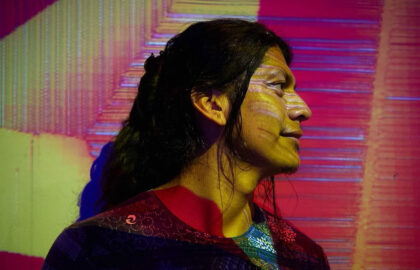

Miami Art Week has become, over the past decade, less a moment on the global art market’s calendar and more a perceptual threshold—where the traditional grammar of exhibition yields to a syntax of experiential amplitude: topographies of light and sound that register not just in the eye, but in the body’s core. This year, Basel’s multifarious events convened around, as much as they enacted, a collective yearning—an interrogation of frequency as perceptual currency, a register through which art and human consciousness enter into a field of mutual modulation.


At the luminous epicenter of this exploration stood Es Devlin’s Library of Us at Faena Beach—a work that is, in tension and harmony, archive, temple, apparatus, and invitation. Far from the language of display that dominates fair pavilions, Devlin’s installation proposed a grammar of participation: the act of reading becoming an act of presence, and the rotation of form a meditation on the temporal complexity of knowing. The triangular carousel of 2,500 books—each chosen for its capacity to transmit rather than instruct—rotated in dialogue with the horizon, an elemental choreography of light and textuality translating beach and sky into a subtle score of human experience. Here, language became a field of resonance, and the visitor—reader, collector, pilgrim—became a co-participant in a mechanism vibrating between history and possibility.
The Library of Us does not merely house texts; it orients attention. By rotating slowly in mirroring surf, it enacts a ceremony of frequency classically understood in physics, now applied to culture: intentional form meeting lived presence. Evening shadows deepen the silhouettes of text; daybreak refracts them against water. In both, the viewer encounters the structural poetry of presence rather than a quick gloss. This is not an artwork that happens to be seen—it is an event in time, a lived threshold.
Devlin’s installation was paired with interior spaces—a cathedral-like reading room and a gallery of auxiliary works—that reframed the exhibition as an environment for thinking. The architecture of cognition was foregrounded, insisting that the act of looking is inseparable from the act of thinking, and that both are shaped by the dialectics of language and silence. Collectors gathered not merely around objects, but around energetic contexts, where each piece inscribed a subtle frequency into the field of perception and conversations often moved beyond market value into metaphysical inquiry.
This qualitative shift—from valuation to attention as currency—was palpable not only at Faena, but across Design Miami, where objects oscillated between sculpture and psychophysical threshold. Crystals, minerals, light-based installations, spatial sound works—these resisted ornament, offering instead vectors of contemplation. In these environments, materiality became secondary to the conditions of consciousness the works enacted: a relational geometry between human presence and luminous unfoldings in space.


Arising against a backdrop of intensified cultural acceleration, this emergent pattern suggests a deeper inflection point. Art making and art collecting are moving toward what might be termed a transductive aesthetics—one in which frequency itself becomes a domain of value. Where traditional critique privileges aesthetic properties or market capital, the vocabulary here shifts toward energetic exchange, perceptual calibration, and collective resonance. In a moment marked by unprecedented technological saturation, it feels almost providential that artistic discourse would return us to primal registers—light, sound, and the tension between presence and memory—as foundations of what it means to be human.
Indeed, Miami Art Week 2025 advanced an argument that aesthetic experience and cognitive evolution are not separate vectors, but mutually implicative dimensions of being. Works that engaged us as perceivers—modulating our internal frequency, inviting reflexive attention to how and why we see—revealed a central insight: art is not merely encountered, but entered, and in doing so, shapes the topology of collective consciousness.
For the collector attuned to this nuance, the implication extends beyond the accrual of objects into the cultivation of fields of resonance within personal and shared spaces. To collect, in this sense, is to invest not just in form, but in states of awareness. The works that endure will be those that persist not merely as aesthetic markers, but as conditions of perception—luminous loci in the ongoing evolution of human consciousness.

Alongside these meditations on collective consciousness, the kinetic works of Brooklyn-based artist BREAKFAST offer a luminous exploration of planetary and human frequencies. Through monumental, interactive sculptures such as Carbon Wake and Consumption, invisible forces—carbon emissions, water cycles, and global patterns of production—are translated into motion, light, and form, rendering the imperceptible perceptible. Each ripple, pivot, and kinetic shift becomes a tangible measure of energy: a choreography of planetary rhythm where human activity and ecological consequence intersect.
In works such as Antarctic Ice and the Climate Shift series, marble, gold-tinted steel, and custom-engineered components capture fragments of the Earth’s pulse—melting ice, shifting tides, and the subtle signatures of human presence. These sculptures do not merely depict data; they mediate it, inviting the observer into a sensory dialogue with forces too vast to comprehend abstractly. Motion and light become carriers of insight, each oscillation evoking both the fragile beauty of the natural world and the volatility of human impact.
BREAKFAST’s installations operate in the interstice between art and perception, between empirical measurement and metaphysical awareness. Environmental data is transformed into fields of experience, asking us not only to witness, but to resonate—to feel the ebb and flow of planetary energy as we navigate our own interior landscapes. The work becomes both mirror and conduit: a luminous interface where Earth’s rhythms align with those of consciousness, and where aesthetic encounter and ecological reflection are inseparable.


A complementary resonance emerged at Design Miami in the work of multidisciplinary artist, sculptor, and alchemist Veronica Mar, whose preview of her Elements collection unfolded less as a presentation of objects and more as a cosmological meditation on matter, energy, and becoming. Minimal in material presence yet expansive in energetic implication, her works operate as Totems of Light, created with conscious intention and sensitivity to vibration. They do not merely occupy a room; they recalibrate it.
Spiral geometry recurs throughout the collection, not as ornament but as cosmic language. The spiral—found in DNA strands, plant growth, ocean currents, and galaxies—functions here as a symbol of eternal movement and spiritual evolution. In Mar’s vocabulary, it signifies life not as linear progression, but as cyclical return, transformation, and ascent. Forms suggest rivers shaping stone, trees winding skyward, canyons carved by time—each gesture echoing nature’s patient intelligence and graceful momentum.
What distinguishes Mar’s contribution within the Design Miami context is her refusal to separate the functional from the metaphysical. Sculpture and furniture are not parallel practices, but interdependent expressions of the same inquiry, each informing the other through scale, intimacy, and use. Sitting, touching, or inhabiting these forms becomes an act of attunement—a way of entering into dialogue with the energies they embody.
In this sense, Mar’s work aligns seamlessly with the broader undercurrents of Miami Art Week: a movement away from spectacle and toward presence, from objecthood toward experience. Her Elements collection does not ask to be consumed visually, but to be felt—an invitation to slow time, listen inwardly, and remember that harmony between matter and spirit is not an abstraction, but a lived frequency.

Closing Reflection: During Miami Art Week 2025, the city became less a backdrop for exhibition than a field of perceptual inquiry, where art, design, and installation operated as instruments of frequency rather than spectacle. This piece traces a subtle yet consequential shift—from object-centered valuation toward experiential resonance—examining works that transform light, sound, data, and form into living interfaces of awareness. From a cultural strategy perspective—one that informs the work we do at AMI Global —these environments signal a broader reconfiguration of how value is constructed: away from accumulation and toward resonance, presence, and perceptual depth. Through installations by Es Devlin, BREAKFAST, and Veronica Mar, contemporary art reveals itself not as representation alone, but as a recalibration of perception itself—inviting us to enter, rather than merely observe, the evolving relationship between matter, consciousness, and collective presence.